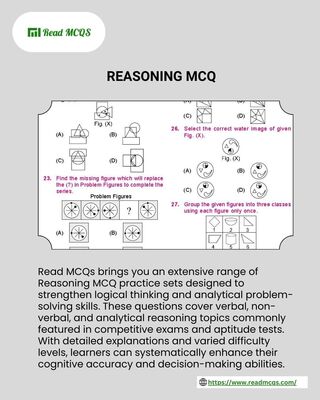
Understanding reasoning mcq Through Effective Practice
-
Reasoning is a core component of aptitude tests, competitive exams, and job assessments. It measures a person’s capability to analyze information, evaluate patterns, and make logical decisions. With growing competition, students increasingly rely on reasoning mcq collections because they provide quick evaluation, immediate feedback, and structured learning. MCQs help learners understand question formats and improve accuracy over time. They also enhance confidence by offering exposure to a wide range of logical problems commonly seen in exams.
Logical Reasoning Essentials
Logical reasoning includes topics such as analogies, blood relations, direction sense, coding-decoding, and series problems. Each topic demands sharp thinking and continuous practice. MCQs allow learners to revisit concepts repeatedly, enabling them to understand hidden patterns and improve decision-making skills. Practising structured sets of reasoning mcq questions further helps students master the fundamentals required to tackle both basic and advanced reasoning tasks.
How MCQs Improve Concept Clarity
MCQs provide instant feedback, which accelerates learning. Understanding why an answer is correct or incorrect sharpens conceptual clarity and reduces confusion. This method also simulates actual test conditions, allowing learners to develop problem-solving strategies. Timed MCQ practice improves speed and accuracy, which are crucial for competitive examinations.
Strengthening Analytical Skills
Analytical skills improve when learners examine every detail before choosing an answer. MCQs encourage this habit by presenting multiple options that require careful evaluation. Topics like syllogism, cause-and-effect, and statement-assumption become easier when practised regularly. Repeated exposure builds mental stamina and enhances the ability to break down complex problems into simpler parts.
Boosting Problem-Solving Speed
Speed plays a vital role in cracking reasoning sections. MCQs enable learners to practise under timed settings, helping them develop quick elimination techniques and pattern-recognition skills. Exposure to diverse question types prepares learners for varying difficulty levels and builds overall confidence.
Progressing From Basic to Advanced
Well-structured MCQ sets help learners transition from simple questions to challenging ones. This progression strengthens understanding and ensures readiness for actual exam scenarios. With consistent effort, students become more comfortable handling tricky reasoning problems efficiently.
Conclusion
Mastering reasoning requires a strategic blend of practice, analysis, and consistency. Using well-crafted reasoning mcq sets enables learners to strengthen logic, improve accuracy, and understand question patterns more effectively. With regular practice, individuals can build strong reasoning foundations that enhance academic performance and career opportunities. Ultimately, the structured approach offered by reasoning mcq resources leads to faster decision-making, improved analytical thinking, and better overall exam success.


