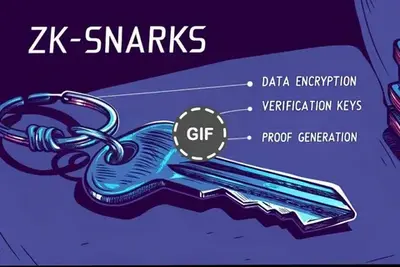
ZK-SNARKs: Compact Cryptography and the Economics of Private Ve
-
Posted by karen khine Filed in Technology #ZK-SNARKs #ZK-STARKs #ZK-KYC #zkEVM #zkTLS #zkSync 127 views
The trade-offs between security, scalability and usability have always limited the adoption of blockchain. At the beginning stages, the technology was interested in demonstrating that decentralized consensus is not entirely infeasible, so technical newness was frequently favored over efficiency. With networks growing and actual economic activity coming into the ecosystem, these initial design decisions began to demonstrate structural constraints. Checking was a bottleneck. The security of transactions was ensured, and it became difficult to scale the transactions effectively without revealing sensitive information. This has necessitated the need to have cryptographic mechanisms that not only assure correctness but also limit the amount of computational and data overhead.
Meanwhile, privacy has now grown beyond being merely a technical preference. Exposure is a risk in a digital economy where the behavior of users, transactional flows, and financial data have an inherent value. Correctness can be validated in systems where investors, institutions and developers are more and more demanding that no underlying data are revealed. This efficiency, privacy and verifiability have become the key to ensuring confidence in online markets. The solution is ZK-SNARKs which fill this in as an answer to the technical and economic limitations, enabling private verification to be done at scale.
Scalable System Compact Verification
The fundamental benefit of ZK-SNARKs is that cryptographic proofs generated are very compact, and easy to authenticate. Conventional verification algorithms are linear functions of the size of the data or computation, i.e. as networks get more complex verification retards and increase resource consumption. When used in high-throughput applications, such as decentralized finance, gaming, or global payment systems, this poses real impediments to adoption.
Small scale cryptography alters economic calculation. When the verification of proofs is small and quick, the cost of participation is low. Less computational power in the system is needed by the validators and network participants, thus decreasing fees and lowering the entry barrier. This efficiency is simply a direct conversion to increased liquidity and increased adoption since more users and institutions will be able to access it without prohibitive costs. ZK-SNARKs allow scalability of decentralized systems without reducing the security of the system or privacy of the user by compressing verification whilst maintaining cryptographic guarantees.
In addition, the size of proofs is also compact, which has consequences on network latency. Smaller evidence implies quicker dissemination between nodes and enhances general throughput as well as makes networks more receptive. This improves a smooth user experience among end users, enhancing interaction and trust. Removing the processes in verifying it, ZK-SNARKs enable networks to run more efficiently without compromising the integrity required to trust financial systems.
Corporate Incentives on Privatization
Checking is not only a technical issue, but also an economic one. Participants in decentralized networks are spending resources to verify validity and ensure system security. Incentives should be synchronized when such undertakings are expensive so that there is regular involvement. ZK-SNARKs enhance this correspondence by eliminating computational costs, ensuring that the cost of verification can be predicted and controlled.
Long-term adoption requires economic efficiency. To a large extent, participants in most blockchain networks have to compromise between security of the system and returns. Verification at high cost may deter honest participation or concentrate validation in a small number of well-endowed participants. ZK-SNARKs reduce the computational expenses and increase the number of participants who have the ability to actively verify the transactions without involving intermediaries. This decentralization ensures that the network is secure and that power is not concentrated, as such, market confidence is enhanced.
Efficient verification has the effect on the market psychology of lowering perceived systemic risk. There is no need to worry that the failure of networks or network bottlenecks would affect results. The awareness that one can easily prove correctness cheaply and privately stimulates an increase in participation, more multi-faceted smart contract application, and eventually increased liquidity into the system. Cryptography is not the most important, as its economics are, and ZK-SNARKs are the best at maximizing both.
Market Differentiator: Privacy
The blockchain trust has always been based on transparency. But with the increased adoption, full transparency has turned out to be a two-sided sword. Although it promises accuracy, it reveals transactional information, user behavior, and trends which can be sensitive to business. This visibility poses risks to individuals and institutions and may restrain uptake in an area where privacy is a regulatory or competitive issue.
The ZK-SNARKs provide a solution to this situation by enabling networks to demonstrate the correctness of calculations without the actual data being exposed. Such selective disclosure is in line with compliance and privacy requirements. Institutions do not have to take risks with sensitive information, and users do not have to feel unsafe using blockchain systems since their financial activity will be secured. Privacy in this manner will be a market differentiator that will increase adoption, liquidity, and system resilience.
Notably, privacy is also network effected. The more players are using the personal verification systems, the more they have faith in the network. The fact that engagement does not need exposure is a reassurance to new entrants to further adopt it. Privacy-saving infrastructure made possible by ZK-SNARKs is self-enforcing over time to establish market expectations of responsible data use and verifiable trust.
Systemic Resilience in the long-term
Scalability and privacy are not technical issues in themselves, but form the basis of resilience in the system. Other networks that are not efficient to verify the transactions at scale are susceptible to congestion, errors, and attacks. The systems used to reveal sensitive information are susceptible to monetary abuse and legal review. ZK-SNARKs solve both dimensions at once, offering a robust verification protocol that scales with the network.
This resilience is an assurance of predictability to investors and developers. Those scaling systems that maintain privacy are not prone to a failure that is catastrophic or results in unexpected bottlenecks that undermine confidence. This in turn decreases volatility and promotes sustainable growth. Having combined cryptographic soundness and economic efficiency, ZK-SNARKs allow networks to withstand the lifespan of hype cycles and permit long-term adaptation and institutional integration.
Conclusion
The future of blockchain technology is more of a balance between three forces, namely efficiency, privacy, and trust. At first designs accomplished either of these, or sometimes both, but seldom all three together. ZK-SNARKs offer a framework that balances these forces and offers smaller and verifiable proofs with reduced barriers to economic participation.
ZK-SNARKs enhance the safety of the network and market trust by lowering the computation cost, maintaining privacy, and making the verification process scalable. They not only make verification be less of a bottleneck but also a growth enabler, developing systems in which technical constraints are less of a limiting factor than market willingness.
In the world where digital assets are coming to the center of finance, the possibility to demonstrate that something is right is no longer a voluntary feature. ZK-SNARKs represent the infrastructure that makes private verification not just possible, but economically viable. They are quietly reshaping the way markets think about trust, scalability, and the role of cryptography in the next generation of blockchain growth.


