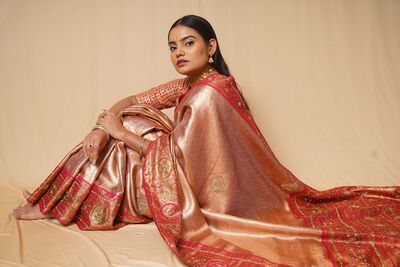
Kanjivaram Saree: The Silent Strength of India’s Handwoven Lega
-
Posted by House of Hind Filed in Shopping #Kanjivaram saree #Indian handloom heritage #pure silk saree #traditional South Indian saree #artisanal silk weaving 86 views
After years of observing Indian textiles evolve with changing lifestyles, one truth remains constant—the kanjivaram saree never loses relevance. It does not chase fashion cycles or adapt for approval. Instead, it stands grounded in its purpose, carrying centuries of knowledge, patience, and cultural confidence within its silk folds.
This saree is not loud. It does not need novelty. Its strength lies in continuity.
The Historical Backbone of the Kanjivaram Saree
A Weave Anchored in Sacred Geography
Kanchipuram, the birthplace of the kanjivaram saree, is not just a weaving town—it is a spiritual and cultural centre. The philosophies that shaped temple architecture also shaped textile design here. Symmetry, balance, and permanence were valued over temporary beauty.
The kanjivaram saree emerged from this mindset, designed to last, not impress briefly.
Knowledge Preserved, Not Written
What makes this tradition extraordinary is that much of the weaving wisdom was never documented. It was observed, practiced, corrected, and perfected on looms. This oral and experiential transfer of skill is rare in today’s world.
Each kanjivaram saree carries this unrecorded intelligence within its weave.
The Material Integrity of a Kanjivaram Saree
Silk Chosen for Strength, Not Softness
The silk used in a kanjivaram saree is deliberately strong. It is meant to hold structure, support heavy zari, and withstand decades of use. Unlike lighter silks, it does not collapse or lose form.
This choice reflects foresight—designing for the future wearer, not just the first.
Zari as a Structural Element
In traditional kanjivaram sarees, zari is not surface decoration. It plays a structural role. The borders and pallu are strengthened using dense zari work, giving the saree weight and balance.
This is why authentic kanjivaram sarees feel substantial and composed.
Design Discipline Over Decoration
Why Kanjivaram Designs Avoid Excess
Experienced weavers understand restraint. Kanjivaram sarees rarely overload the body with motifs. Instead, attention is focused on borders and pallus, allowing the saree to frame the wearer rather than overpower her.
This design discipline is the reason the saree ages gracefully.
Symbolism Embedded in Patterns
Every pattern has intention. Checks and lines represent order and stability. Floral elements symbolise growth and continuity. Temple borders signify protection.
These designs are not trends; they are visual philosophies.
The Weaving Process: A Lesson in Precision
Time as a Critical Ingredient
A kanjivaram saree cannot be hurried. Each stage—from preparing silk to weaving zari—requires waiting, checking, and correcting. Even minor errors are undone rather than adjusted.
This respect for process is what separates handloom excellence from mechanical output.
Sectional Weaving Technique
Body Section
Woven with uniform silk tension for longevity.
Border Section
Woven separately using thicker zari threads.
Pallu Section
Given the highest attention due to its narrative role.
These sections are later interlocked using a traditional technique unique to kanjivaram sarees.
The Emotional Role of the Kanjivaram Saree
A Marker of Important Life Moments
Across generations, the kanjivaram saree has been present during weddings, religious ceremonies, and family milestones. Its presence signifies seriousness, respect, and celebration.
It is chosen when moments matter.
From Personal Use to Collective Memory
A well-preserved kanjivaram saree often outlives its original owner. It becomes part of family memory, carrying stories without words.
Few garments achieve this emotional permanence.
Identifying Authentic Craftsmanship
Characteristics That Cannot Be Replicated
A genuine kanjivaram saree shows:
-
Firm interlocking of body and border
-
Rich silk texture with controlled shine
-
Consistent zari density
-
Clear contrast between design elements
These qualities come only from experience, not imitation.
The Kanjivaram Saree in Contemporary Life
Adapting Without Dilution
Modern kanjivaram sarees may experiment with colours and layouts, but the core weaving structure remains untouched. This careful evolution ensures relevance without cultural compromise.
Change is allowed, erosion is not.
Global Appreciation Rooted in Authenticity
The kanjivaram saree’s global recognition comes not from marketing but from substance. When international audiences encounter it, they sense depth, not novelty.
Authenticity travels farther than trends.
Sustainability as an Inherent Value
Handloom as Responsible Practice
Kanjivaram weaving relies on manual skill rather than industrial scale. It consumes minimal energy, produces little waste, and supports artisan families.
Long before sustainability became a concept, this craft practiced it naturally.
Longevity Reduces Consumption
A saree that lasts decades reduces the need for replacement. This longevity is sustainability in its most honest form.
Why the Kanjivaram Saree Will Always Matter
Cultural Confidence Over Fashion Approval
The kanjivaram saree does not adapt to fit global fashion narratives. Instead, it invites the world to understand its values. This confidence ensures its survival.
A Living Example of Indian Excellence
It represents what India does best—patient craftsmanship, symbolic design, and respect for tradition.
Conclusion: A Saree That Teaches Us How to Endure
The kanjivaram saree teaches an important lesson in today’s fast-moving world: things of value are built slowly. Through disciplined weaving, thoughtful design, and cultural grounding, it has remained relevant without reinvention.
It is not just worn—it is honoured.
Not just preserved—it is lived with.And that is why the kanjivaram saree will never be outdated, only rediscovered by every generation.
-


