
Categories
Tags
-
#fleet insurance
#RFP in Healthcare
#Retail Store Installation
#filler for wrinkles around the mouth
#A-frames
#Healthcare SEO
#Poland tour from Wieliczka
#employee handbook translation services
#Honeycomb Paper Bubble Wrap
#Business Law Attorneys
#Animal symbolism
#PDA in a Relationship
#Facial Lymphatic Drainage Massage
#Cloud video surveillance
#Tax deed
#Cloud ERP Solutions
#natural lip fillers
#allergies on skin
#ATA certified translator
#recruitment and selection process in HRM
#2D barcode scanners
#Gourmet Rice Krispie Treats
#ADA-compliant
#Contextual Video Advertising
#Jungian Archetypes
#bathroom pods for commercial construction
#Ankle Bone Fracture Treatment
#ERA home security
#medical imaging
#Enterprise Application Integration
Archives
AI Model Evaluation Standards for Medical Imaging Platforms
-
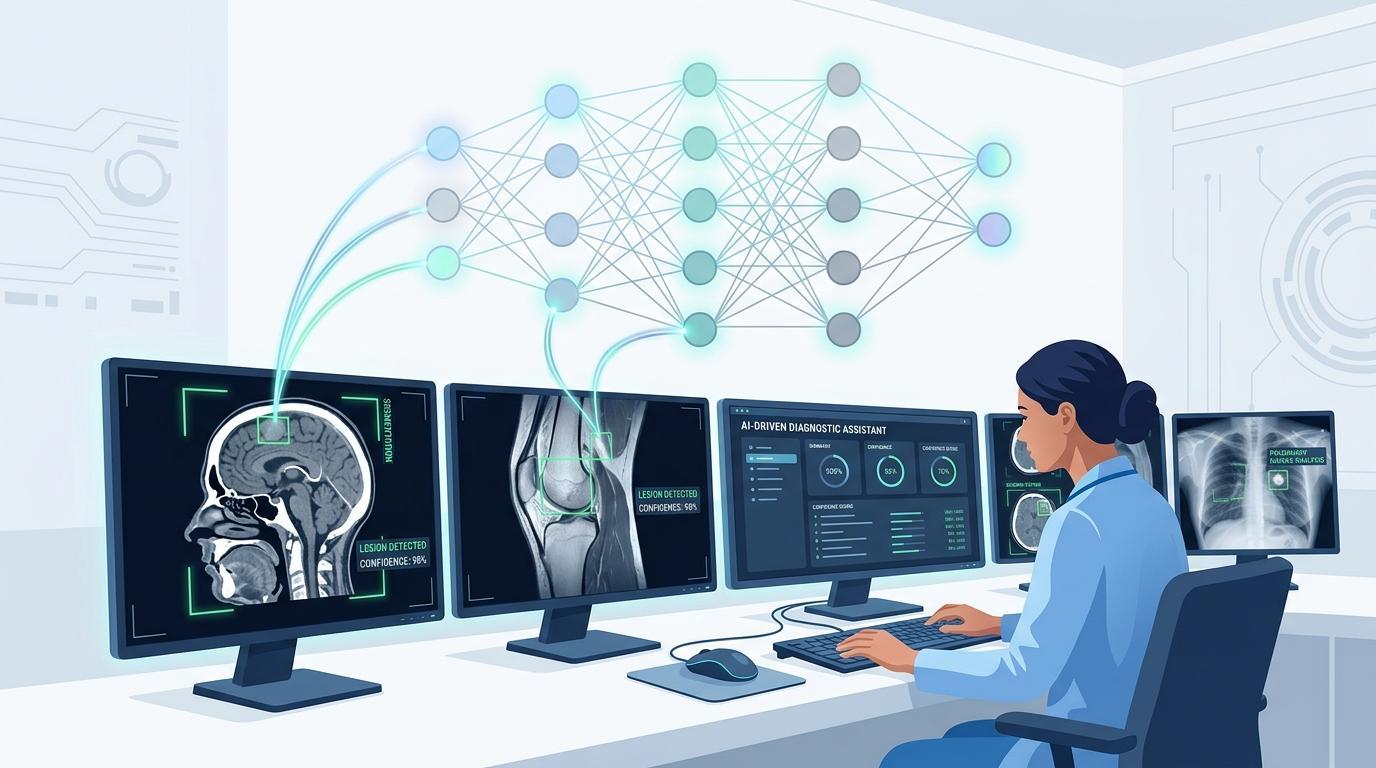
Summary: Medical imaging platforms require strong evaluation standards to ensure reliability across real-world healthcare environments. Continuous testing, expert review, edge-case analysis, and operational oversight help organizations improve consistency, strengthen clinical trust, and maintain dependable imaging performance under complex clinical conditions where patient outcomes and diagnostic accuracy remain critically important.
Medical imaging has always carried enormous responsibility.
A single scan can change everything. It can confirm a diagnosis, reveal a hidden condition, guide surgery, or completely alter a patient’s treatment path. Behind every image sits a real person waiting for answers, often anxious, exhausted, and hoping for clarity.
That’s why evaluation standards for medical imaging platforms matter so much.
Not because healthcare organizations love checklists or compliance discussions. They matter because reliability in imaging directly affects clinical confidence, workflow efficiency, and patient outcomes. And in environments where decisions happen quickly, even small inconsistencies can create serious consequences.
As medical imaging platforms become more advanced, healthcare organizations are asking harder questions.
Not just:
“Can the system detect abnormalities?”
But:
- “How consistently does it perform?”
- “What happens during difficult cases?”
- “How does it behave across different hospitals, imaging devices, and patient populations?”
- “Can clinicians trust the outputs under pressure?”
Those questions sit at the heart of modern evaluation standards.
And honestly, they should.
Strong Evaluation Starts With Clinical Reality
One of the biggest problems in medical imaging evaluation is the temptation to rely too heavily on controlled testing environments.
Perfect scans. Clean datasets. Balanced cases.
Real healthcare doesn’t look like that.
In actual clinical settings, imaging quality varies constantly. Some scans contain motion artifacts. Others come from older equipment. Patient positioning changes. Noise levels differ between facilities. Rare conditions appear unexpectedly. Even experienced radiologists occasionally disagree on interpretations.
That complexity matters.
A medical imaging platform may perform exceptionally well in controlled testing while struggling once it encounters the unpredictability of real clinical workflows.
That’s why strong evaluation standards focus heavily on real-world variability.
Healthcare organizations increasingly expect imaging systems to be tested across:
- Multiple healthcare environments
- Diverse patient populations
- Different imaging hardware
- Variable scan quality
- Rare clinical presentations
- Complex edge cases
- Inconsistent real-world inputs
Without that diversity, evaluation results can become misleadingly optimistic.
And healthcare simply can’t afford false confidence.
Accuracy Alone Isn’t Enough
Accuracy metrics dominate a lot of healthcare technology conversations.
Sensitivity. Specificity. Detection rates.
Yes, those numbers matter. Absolutely.
But medical imaging reliability goes beyond statistics.
A platform might achieve excellent benchmark scores while still creating practical problems inside clinical environments. Maybe it produces outputs clinicians find difficult to interpret quickly. Maybe it behaves inconsistently across imaging centers. Maybe it struggles when scans contain subtle abnormalities that fall outside common patterns.
Those issues don’t always appear during surface-level testing.
That’s why modern evaluation standards increasingly include broader performance indicators such as:
- Workflow integration
- Consistency across environments
- Edge-case handling
- Interpretability
- Reviewer confidence
- Operational reliability
- Long-term performance stability
Because healthcare professionals don’t just need technically accurate systems.
They need dependable systems that support real decision-making under real conditions.
There’s a difference.
Human Review Remains Essential in Imaging Evaluation
Medical imaging has always involved interpretation.
And interpretation involves nuance.
A subtle shadow on a scan may appear insignificant initially but carry important clinical meaning once the patient's history enters the picture. Two specialists may review the same image differently based on experience, context, or risk assessment.
That’s exactly why human review remains a critical part of imaging evaluation standards.
Experienced radiologists and clinical reviewers bring contextual understanding that structured testing alone often misses. They recognize ambiguity. They identify borderline cases. They understand how imaging findings connect with broader clinical decision-making rather than existing in isolation.
More importantly, they help organizations evaluate whether outputs are genuinely useful in practice, not just statistically impressive on paper.
Strong evaluation frameworks often include:
- Multi-reviewer consensus workflows
- Expert disagreement analysis
- Edge-case validation reviews
- Continuous reviewer feedback
- Longitudinal quality assessment
Interestingly, disagreement itself can become valuable during evaluation.
When specialists interpret difficult cases differently, it reveals the complexity the system must navigate carefully. Ignoring those gray areas during testing creates reliability risks later.
Healthcare rarely operates in absolutes.
Evaluation standards shouldn’t pretend otherwise.
Edge Cases Define Real Reliability
Average scans rarely expose serious weaknesses.
Edge cases do.
And medical imaging platforms encounter edge cases constantly once deployed at scale.
A rare disease may appear in an unusual form. Image quality may degrade unexpectedly. Anatomical variations may complicate interpretation. Clinical history may conflict with imaging findings.
These situations challenge even highly experienced professionals sometimes.
That’s why evaluation standards increasingly emphasize stress testing against difficult scenarios rather than focusing solely on routine cases.
Organizations need visibility into questions like:
- How does the platform behave during uncertainty?
- Does performance drop across rare conditions?
- Can difficult findings still be interpreted reliably?
- How does the system respond to incomplete information?
- Are confidence levels communicated appropriately?
Because reliability in medical imaging isn’t measured only by average performance.
It’s measured by how systems behave when cases become complicated, ambiguous, or unfamiliar.
That’s where trust is either strengthened or lost.
Continuous Evaluation Matters After Deployment
One of the most important shifts happening in medical imaging evaluation is the recognition that testing cannot stop after deployment.
Healthcare environments evolve constantly.
Imaging devices change. Clinical workflows shift. Patient demographics vary over time. New conditions emerge. Data quality patterns fluctuate between facilities.
Without ongoing evaluation, organizations risk assuming reliability remains stable indefinitely.
But healthcare rarely stays static long enough for that assumption to hold.
Continuous evaluation helps organizations:
- Detect performance drift
- Monitor workflow impact
- Identify reliability changes
- Reassess difficult case handling
- Maintain clinical trust
- Improve systems iteratively over time
This creates a much healthier operational model.
Instead of treating evaluation as a one-time checkpoint, organizations build ongoing oversight directly into imaging workflows.
And honestly, that approach feels far more aligned with how healthcare actually functions.
Trust Is the Foundation of Imaging Adoption
Medical imaging professionals work under intense pressure.
Radiologists manage high case volumes. Clinicians depend on accurate interpretations. Patients wait anxiously for results that may completely change their lives.
In that environment, trust becomes everything.
Healthcare professionals need confidence that imaging platforms behave consistently, handle uncertainty responsibly, and support decision-making without introducing unnecessary confusion or risk.
That confidence doesn’t come from flashy demos or marketing claims.
It comes from rigorous evaluation.
It comes from seeing how systems perform across difficult scenarios, real workflows, and diverse patient populations. It comes from continuous oversight, expert review, and transparent performance monitoring over time.
Strong evaluation standards help build that trust slowly but meaningfully.
And without trust, adoption becomes incredibly difficult, no matter how advanced the technology appears.
The Future of Medical Imaging Will Depend on Better Evaluation
Medical imaging platforms are becoming more sophisticated every year. Their capabilities continue expanding across diagnostics, workflow support, prioritization systems, and clinical analysis.
But as complexity grows, evaluation standards become even more important.
Healthcare organizations can no longer rely on narrow testing approaches or isolated benchmark metrics alone. They need comprehensive evaluation frameworks grounded in clinical reality, operational reliability, human oversight, and long-term performance monitoring.
The organizations leading this space understand something important:
Reliable imaging systems aren’t built through technical performance alone.
They’re built through careful validation, continuous evaluation, and deep alignment with real healthcare environments.
That’s what creates sustainable trust.
And in healthcare, trust will always matter more than hype.
Conclusion
Evaluation standards for medical imaging platforms play a critical role in ensuring reliability, clinical trust, and long-term performance across real-world healthcare environments. Strong evaluation frameworks combine expert review, edge-case analysis, operational testing, and continuous oversight to help organizations build imaging systems capable of supporting safer and more dependable clinical decision-making.
Looking to strengthen medical imaging evaluation workflows with expert-driven review systems and scalable validation infrastructure? Connect with Centaur.ai to explore how advanced evaluation standards can support more reliable imaging platform performance.
FAQs
1. Why are evaluation standards important for medical imaging platforms?
Evaluation standards help healthcare organizations assess reliability, consistency, and clinical performance across diverse imaging environments, patient populations, and real-world workflow conditions.
2. Why isn’t accuracy alone enough in imaging evaluation?
Strong accuracy scores may not fully reflect workflow compatibility, edge-case performance, interpretability, or operational reliability in real clinical settings.
3. What role do human reviewers play in imaging evaluation?
Human reviewers provide contextual understanding, expert interpretation, and edge-case analysis that help organizations improve reliability and identify issues automated testing may overlook.
4. What are edge cases in medical imaging?
Edge cases include rare conditions, unusual scan presentations, poor image quality, or highly complex clinical situations that may challenge system reliability.
5. Should imaging platforms be evaluated continuously after deployment?
Yes. Continuous evaluation helps organizations monitor performance changes, detect drift, reassess reliability, and maintain trust as healthcare environments evolve.


