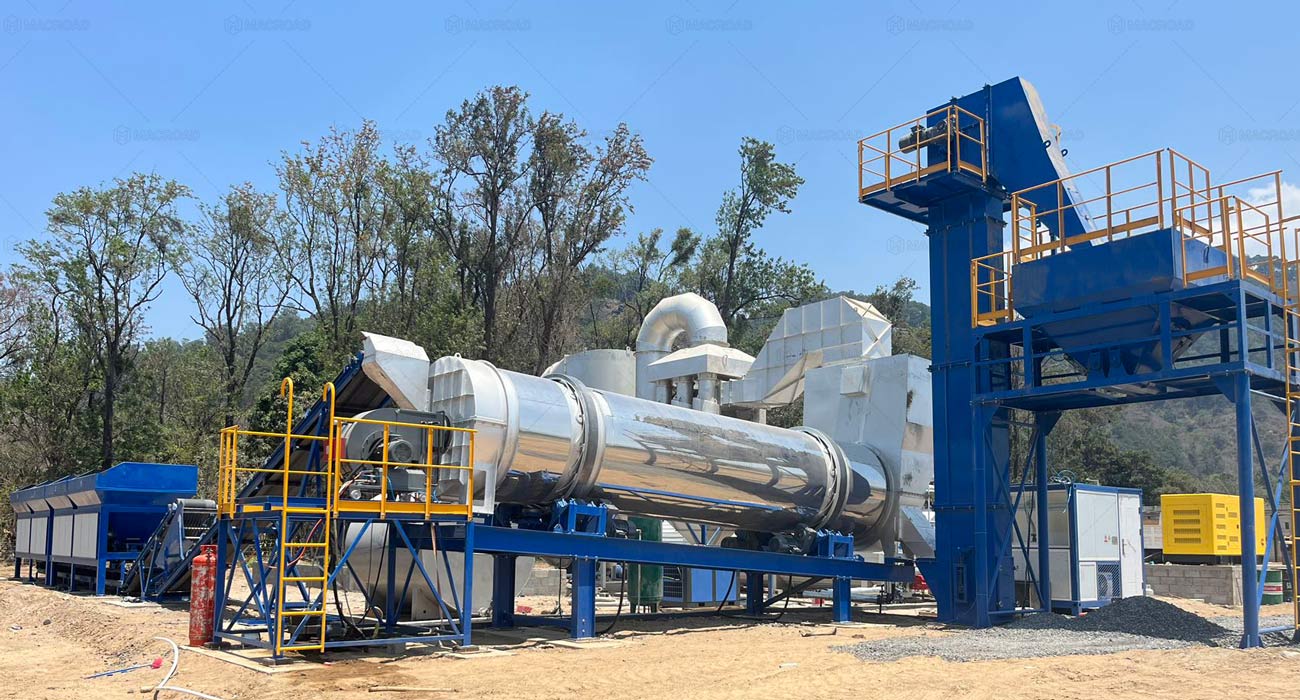
The critical vulnerability in desert paving emerges not from equipment ratings but from thermal decay during high-wind haulage. When a hot asphalt mixing plant discharges into uninsulated trucks for extended transport, aggregate segregation and surface cooling create discrete cold chunks that disrupt screed harmony. An asphalt paver machine without responsive elevation and slope controls cannot compensate for these thermal anomalies, producing density variations that microscopic examination reveals as incipient cracking planes.
The Physics of Thermal Decay in Harsh Environments
In light of this, wind exposure accelerates heat loss far beyond ambient temperature predictions. Specifically, haul trucks moving at 50 km/h through desert corridors experience convective cooling rates three times higher than stationary conditions. The mix surface drops below 140°C while the core remains plastic, creating a crust that shatters under paver auger action and distributes cold fragments across the mat width.
Conversely, an asphalt paver machine equipped with sonic screed sensors and rapid-response elevation actuators can detect thermal-induced density changes in real time. From a logistics perspective, these systems adjust tow-arm pressure within milliseconds to maintain pre-compaction thickness despite variable feed consistency. Without this capability, cold chunks create longitudinal streaks that roller patterns cannot eliminate, leaving density differentials exceeding 5% of target.
Consequently, the financial exposure extends beyond immediate rework. Temperature differentials in the 20–30°C range trigger differential shrinkage during cooling, generating transverse micro-cracks invisible to visual inspection but detectable through forensic coring. These defects mature under thermal cycling and traffic loading, voiding 3-year performance bonds through premature fatigue failure rather than structural collapse.
Surge Silo Architecture as Risk Mitigation
The absence of an insulated surge silo at the hot asphalt mixing plant forces a direct coupling between batch discharge and paver demand. Specifically, any truck delay—mechanical failure, traffic conflict, or plant stoppage—breaks the thermal chain and mandates a construction joint. The stop-start mat exhibits distinct thermal signatures: the trailing edge cools below binding temperature while the fresh head remains workable, creating a density discontinuity at the interface.
From a logistics perspective, insulated silos provide 4–6 hours of thermal buffering, allowing continuous paving despite upstream interruptions. The mass of stored mix maintains uniform temperature distribution, eliminating the surface-crust phenomenon that generates cold chunks. Contractors operating without this buffer face a binary choice: accept joint liability every 30–40 truckloads, or risk thermal segregation by forcing marginal material through the asphalt paver machine.
In light of this, the surge silo represents insurance against bond forfeiture rather than mere production convenience. The cost of silo installation typically equals 2–3% of plant capital but prevents the strip-and-replace scenarios that consume 15–20% of contract value. Specifically, thermal mass storage allows batch plants to approximate continuous-mix uniformity, matching mat quality expectations in performance-specified contracts.
Screed Intelligence and Operational Protocols
When thermal continuity cannot be guaranteed, asphalt paver machine configuration becomes the final defense against cold-chunk propagation. Modern screeds with independent thermal profiling detect feed temperature variation through infrared sensors, automatically adjusting vibration frequency and tamper stroke to compensate for reduced workability. These adaptations preserve density despite material inconsistency, though they cannot fully eliminate the micro-structural damage of thermally degraded binder.
Conversely, manual screed operation relies on operator vigilance to identify cold chunks visually—a response latency measured in seconds rather than milliseconds. By the time adjustment occurs, the defect is embedded at 80% of final elevation, requiring aggressive rolling that risks aggregate fracture or binder migration. From a logistics perspective, high-wind desert corridors amplify this challenge by accelerating surface cooling beyond human reaction capacity.
Consequently, contractors must specify screed control systems with feed-forward algorithms that anticipate thermal decay based on haul distance, wind speed, and truck insulation quality. The integration of hot asphalt mixing plant discharge records with paver positioning data enables predictive adjustment before cold material reaches the screed. This telemetry bridge transforms reactive compensation into proactive prevention, preserving bond security against forensic examination.
Conclusion
The synchronization between hot asphalt mixing plant output and asphalt paver machine capability determines pavement durability under desert stress. Thermal decay during high-wind haulage generates cold chunks that screed intelligence must detect and neutralize before compaction. Insulated surge silos eliminate the stop-start liability that triggers microscopic cracking and bond forfeiture. Contractors prioritizing thermal continuity over nominal throughput secure long-term performance guarantees rather than accepting incremental degradation as operational reality.